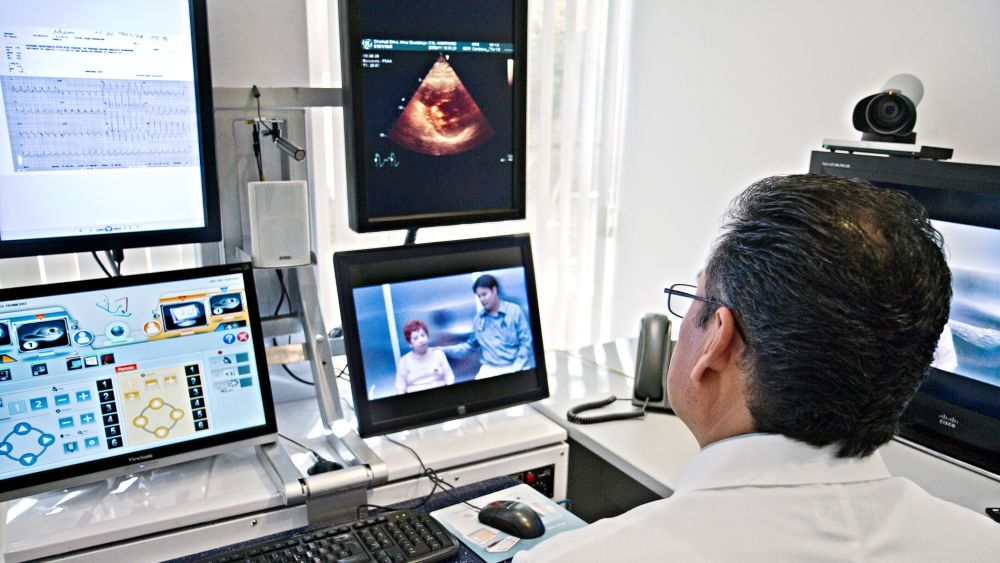
Telehealth
The healthcare industry is going to be revolutionized because you will have sensors at various points of your body measuring different things and a computer somewhere or maybe a doctor will be examining you all time – Marty Cooper

image by: Getty Images For Unsplash+
HWN Suggests
The Promise and the Peril of Virtual Health Care
Not long ago, the idea of “seeing a doctor” without actually going anywhere would have seemed far-fetched. But at a time when we can deposit checks, buy and sell antiques, and take classes in astrophysics from our mobile devices, virtual healthcare that goes beyond fitness apps and WebMD is becoming part of our new reality. More patients are making virtual contact with medical professionals every day, thanks to the advanced information and communications technologies that support telemedicine. Beyond connected devices (such as glucose and cardiac monitors) that stream data directly to hospitals and doctors’ offices, telemedicine involves videoconferencing and electronic exchange of ultra-high-resolution…
Featured
 Is telehealth a good idea, or should I see my regular doctor?
Nobody can deny the ease of telehealth. You can schedule appointments within hours — sometimes minutes — of realizing you need care and see a doctor from your couch, in your pajamas.
Articles of Interest
Docs OnLine - The Doctor is in Somewhere
From consulting and diagnosing to performing telesurgery, virtual medicine is here to stay and continues to proliferate. Can on-line medicine truly replace traditional face-to-face medical practice?
How telehealth can get healthcare to more people
So if telehealth is such an obvious solution to the problem of healthcare access, why has it not been adopted as readily as the railroads were in the 1800s? There remain multiple barriers.
Older adults have a hard time accessing virtual health care
Telemedicine has been vital during the pandemic, but not everyone is equipped for it.
The Hype of Virtual Medicine
High-tech health care hasn’t proved effective at changing patients’ bad habits.
The Promise and Perils of Virtual House Calls
With digital technology that can bring distant experts as close as your smartphone, telemedicine is on the rise. Now comes the tricky part.
Are the benefits of telehealth a myth?
Telehealth could ease the pressure on health services struggling with ageing populations. It sounds like a no-brainer. Don't force people with long-term health problems like diabetes or chronic lung disease to trek in to hospital for routine tests and repeat prescriptions - monitor their conditions remotely instead.
Bring On the Virtual Doctors
If it means, in this resource-strapped era, that more patients will have access to good care, and that good doctors will be able to spend more time with their patients, then let’s bring on the virtual doctors.
Coronavirus Scare Gives Telehealth an Opening to Redefine Healthcare
With the coronavirus threatening to become a pandemic, health systems and telehealth vendors see this as an opportunity to bring connected health to the forefront - and reshape the future of healthcare.
Doctors and Patients Turn to Telemedicine in the Coronavirus Outbreak
The use of virtual visits climbs as a way of safely treating patients and containing spread of the infection at hospitals, clinics and medical offices.
He's building virtual roads to wellness
Jamey Edwards is chief executive of Cloudbreak Health, a telemedicine company that connects doctors with patients and translators using a private broadband network.
How Telehealth Platforms Will Reshape U.S. Healthcare Delivery
Telehealth is far more than a new means of visiting the doctor. It’s the gateway to a new system of coordinated care platforms: Services that leverage the expertise of people with advances in technology. As these platforms become ever more sophisticated, while delivering better health outcomes at lower costs, they will fundamentally reshape the delivery of U.S. healthcare.
Making the case for mHealth, telehealth collaboration
Telehealth and mHealth supporters have long sought to stake a claim to different parts of the healthcare landscape. But proof is emerging that the lines are blurring, and that the future – and the success of both concepts – might lie in integration.
Mobile health faces a bumpy road in rural California
Adopting m-health would allow doctors to reach out through mobile phones and tablet apps to conduct examinations while such patients remain at home; track exercise, blood pressure or other metrics; send reminders to take a walk or take a pill; or deliver information to help manage chronic ailments. But spotty cellular networks in the southern Sierra create problems for people using mobile apps.
Silicon Valley pushes healthcare via text in pandemic virtual care boom
Millions have avoided in-person consultations in the past year and providers see ‘asynchronous’ care as the future of health.
Telehealth grew wildly popular amid Covid-19. Now visits are plunging, forcing providers to recalibrate
While telemedicine use largely remains well above pre-pandemic levels — and many still say telemedicine’s popularity is here to stay — the recent downturn in visits has created an undeniable whiplash effect. Hospitals that rushed to retrain their staff to deliver most types of care virtually in March are now trying to strike a new balance based on shifting patient preferences and needs.
Telehealth Is About to Abruptly End for Seniors
“People are going to go to sleep tonight having had telehealth coverage since the beginning of the pandemic—and most of them have used it one way or another,” said Kyle Zebley, the executive director of ATA Action, the advocacy arm of the American Telemedicine Association, on Sept. 30. “They will wake up in the morning not having that coverage.”
The Doctor That Never Sleeps
How will telemedicine shape the future of patient-doctor relationships?
Using Phones to Connect Children to Health Care
Telemedicine has been much in the news as researchers investigate how technology can extend the reach of medical services, and a host of start-ups and app developers look for ways to incorporate medical care into our relationships with our devices. And so in pediatrics, there is discussion about the potential for making health part of that adolescent connectedness.
When Health Care Moves Online, Many Patients Are Left Behind
Amid the Covid-19 pandemic, more doctors are turning to telemedicine. That's a problem for tens of millions on the wrong side of the digital divide.
Why Your Shrink Wasn’t Offering Virtual Therapy Until Now
Did it need to take a pandemic to let us Zoom with our therapist in our PJs?
Resources
6 things to know about telehealth
Health care in the United States has never been easy, but with the coronavirus pandemic, a visit to the doctor’s office is just plain risky. That’s why this crisis has become a moment for telehealth, which connects patients to doctors through the internet.
Telehealth and Medicine Today
Telehealth and Medicine Today (TMT), is an open access online, international peer review journal where multidisciplinary thought leaders, practitioners, and future society stakeholders converge to address strategic, medical, technical, legal, policy, economic, and social aspects of a new health and technology sector.
California Telehealth Network
CTN is California’s leading agency focusing on increasing access to healthcare through the innovative use of technology which includes telehealth, telemedicine and health information exchange.
e-Telmed
e-Telmed, Inc. supplies a single source solution that incorporates all of the necessary components to successfully implement a telehealth program. All of the hardware, software, peripheral devices, customer support and legal advice are provided in a seamless package that allows ease of use and integration with any HL7 compliant infrastructure.
GlobalMed
GlobalMed, a privately held telemedicine company headquartered in Scottsdale, Arizona, is the leader of telemedicine companies in telehealth hardware and software R&D, design, engineering, manufacture and support. Our team of telemedicine software developers and engineers work closely with scientific and medical professionals–from concept to application–to understand and translate unmet needs into next-generation integrated telemedicine tools that are unsurpassed in quality, affordability and flexibility.